Home / Volume One
Volume One · The Ten-Minute Man
You show up at work. You show up for the people who count on you. Maybe you show up at the gym. That is discipline, and you have had it the whole time.
You just never spread it out. There are four areas — body, provision, mind, and spirit — and most men train one while the other three run on whatever is left over.
A system. Lived. Tested. Refined.
The Tempered StandardThe part you don’t say out loud
You got winded carrying a laundry basket up the stairs and you looked around to see if anyone heard it.
The card got declined at the register. You laughed, said try the other one, and moved money around that night after everyone was asleep.
You picked up your phone to check one thing. You set it down forty minutes later and could not name a single thing you had looked at.
You said grace at the table with your kid watching, and you knew it was the only thing you had said to God all week.
She still asks. You used to train. You used to pray with me. You used to get on the floor with the kids. You used to talk about that job like it was actually going to happen. And you have an answer ready every single time — and you have heard yourself give it so often that you stopped believing it somewhere along the way too.
Your kid asked you to come see something. You said in a minute. He waited. And then at some point — you do not know when — he stopped asking.
You caught yourself in a window or a photo and did not recognise the guy standing there. Not older. Softer. Like something got let go of and nobody told you.
None of that is a crisis. That is exactly the problem. A crisis you would fight. A crisis would give you something to push against and a day to point at. You don’t know you’re drifting until you are already somewhere you did not choose. This just accumulates, quietly, in ten thousand small surrenders that each seemed reasonable at the time.
And the worst part is not the moment. It is the sentence that comes after it — the one you say to yourself, every time, in the same flat voice: I need to get it together.
You have been saying that for years. You are not going to say it again after this page.
Four questions
Your wife. Your kids. Whoever it is you made a promise to.
Could you carry them out of danger? Not in theory. Out of a car on its side. Down a staircase. Across a parking lot. Dead weight, no warning, no warm-up, and nobody coming to help.
If the truck dies this month, is that a problem or a crisis? Do they hear about it from you, or do they work it out from the account?
Can you give them ten minutes? Phone in another room. Sit down and listen to the whole thing without defending yourself once. Not hear it. Listen. And do not try to fix it. That is what being present actually costs.
When did you last pray for them on purpose? For your family by name, and for your own direction, out loud, when nothing was on fire.
Body. Provision. Mind. Spirit. One question for each of the four, asked about the people you answer to — and you already know which one you would fail.
That is not a guilt trip. That is a map. The one you flinched at is the one to start on.
Two minutes. Four questions. No email required.
What it costs
No man wakes up and decides to get weaker, quieter, softer, further behind. That is what makes drift dangerous — it does not announce itself. It happens in the gaps where nothing was decided, and it takes years, so there is never a day you can point at.
Every area you leave untrained is a decision you hand to someone else. Can’t protect? Someone else decides what happens to what’s yours. No money set aside? The bill decides your month. No plan? Whoever talked to you last decides what you think. No standard? You answer to whatever you felt like at six in the morning.
Most of it never arrives as a crisis. It arrives as a Tuesday that looks like every other Tuesday, and a man who cannot say what changed. And when it does finally show up as a crisis, it is the bill for a hundred Tuesdays that did not look like anything at all.
What this does differently
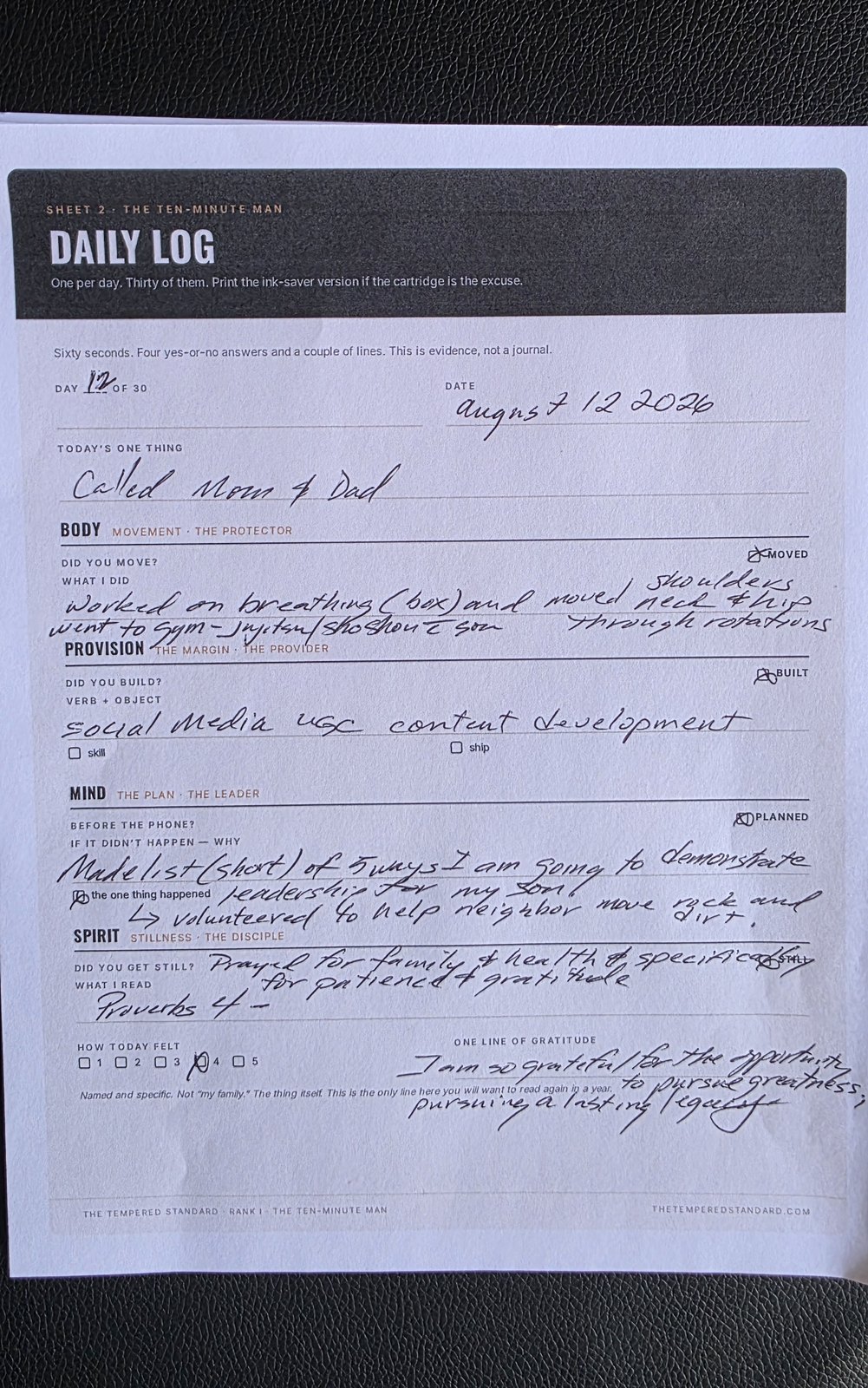
The floor is ten minutes on each of the four, every day, for thirty days. Body, provision, mind, spirit. Forty minutes total, and it is small on purpose — small enough that you have no honest excuse on your worst day. No man skips the floor. That is not gatekeeping, it is arithmetic: you cannot run a personal practice — yours, built around your life, not a program handed to you — if you have never proved you will show up for it.
After the thirty, the four move at their own speed. You will be further along on one than the others. Everybody is.
Rank describes how much work and responsibility a front can reliably carry. Rank belongs to the front, not to the man.
Volume One
A system that pretends otherwise is measuring something you are not.
And when you miss, you re-enter. You do not restart. The falling is assumed. The rising is what gets measured. You will miss, and early on you will miss twice, and that is not the thing that ends it. Miss once, never twice is the aim, and it is a protocol before it is a standard — the morning after already has an instruction in it, written before you needed one.
Here is the difference. A streak gives you one number, and the day you miss it drops to zero — as if the eleven days before it never happened. This gives you a floor low enough to hit on a bad day, four areas that each move at their own speed, and a way back in the next morning. The work is the same. What changed is what happens when you fall off.
Why nothing has stuck
You are functioning. The job is handled, the bills are paid, the people who depend on you are fed. From the outside there is nothing to point at.
But there is a hum underneath it that says this is not it, and you have no word for what it is. So you go looking. You start something. You do not finish. You start something else and half-do it and let it go, and you tell yourself you have just been busy.
It is not laziness and it is not weakness. You have proved you can do hard things — you do them for other people every week without being asked. The follow-through is not missing from you. It is missing from three parts of your life that nothing was ever built for.
Maybe you ran something hard and it broke. A streak, a countdown, a rule you do not break. You were good at it for eleven days, and then a kid got sick or the job went sideways and you missed one — and the thing said start over at zero. So you did not.
Maybe you never started. You have been going to start for two years. Monday, after the holidays, once work settles down. You are not lazy; you have carried heavy things for other people your whole life. You just never put yourself on the list.
Or maybe you go hard — at one thing. You are strong and broke. Or steady with money and a wreck inside. You have real reps, years of them, and they all live in one area while the other three go untrained.
Three roads, one place. And in every case the problem gets diagnosed the same wrong way: I lack discipline.
You do not lack discipline. You lack direction, and you lack a practice to aim it with. Nobody ever handed you a structure that covers all four areas, sets a floor you can hit on your worst day, and tells you what to do the morning after you miss. Without that, effort goes where it always went — and three parts of your life keep quietly running on empty.
Willpower gets blamed for this. Willpower is a mood — it shows up when you slept well and nothing went wrong, and it is the first thing gone on the day you actually need it. A standard is a structure. It does not care how you feel, and that is the whole mercy of it.
A practice, not a habit
Every program you have tried promised the thing would go automatic — that one day you would stop deciding and it would just run. A habit is exactly that: something you stopped deciding. Which is why a habit that breaks is gone.
A personal practice is chosen every single time. It has a floor, it gets audited once a week, and it has a way back in — because it was a commitment and not a reflex. The choosing does not disappear. It gets faster, until the choosing is who you are.
Start free
The free guide isn’t a teaser that ends right when it gets good. It’s the real frame: the manifesto, the warrior-in-the-garden idea, the four pillars, and the creed. Enough to know exactly what Tempered asks of you — and whether you’re in.
Twelve pages, free. Give us a name and an email and it’s in your inbox in a minute.
12 pages · PDF · yours to keep
Free guide · PDF
The starting point. The full system is Volume One.
Volume One · the full system
Yours to keep.
Volume One
The Ten-Minute Man is the first volume of the system — the full creed, all four pillars, the thirty days, and all nine sheets. One system. Yours to keep.
Buy it once. The Forge and The Watch follow as their own volumes.
You have known for a while. What you have never had is something built to cover all four at once.
That is Volume One. Ten minutes on each, thirty days, and a way back in every time you fall off — because you will. One price, yours to keep.
Volume One — The Ten-Minute Man. $29.99. Yours to keep.